The Persian Podcasting Industry: An Analysis of the Iranian Audio Market
Podcasting in Iran has come a long way. What started as a niche hobby in the early 2010s has exploded into a massive cultural force over the last five years. Today, it’s not just for techies; it’s where millions of Persian speakers go for education, self-improvement, and a sense of connection. In fact, the Iranian podcast market is currently growing as fast as the global average (if not faster), fueled by a young, urban population that can’t get enough of high-quality audio.
A Market That Speaks for Itself
A key thing to understand about Iran’s podcast market is the language it operates in. Iran speaks Persian (also known as Farsi), one of the world’s most widely spoken languages with an estimated 100–110 million speakers globally. It is the official language of Iran, Afghanistan, and Tajikistan, with around 70 million native speakers in Iran alone. This matters enormously for the podcasting landscape: unlike much of the broader Middle East and North Africa, which shares Arabic as a common language and therefore a largely common content ecosystem, Iran sits in its own distinct linguistic world. The Arabic-speaking podcast market spans over 20 countries and some 400 million people; but Iranian creators and listeners aren’t part of it. Persian content is produced for Persian speakers, and Persian speakers consume Persian content. That makes Iran’s podcast market not just a subset of a regional trend, but a self-contained and fast-growing ecosystem in its own right.
The Big Picture: Podcasting in Iran and the Middle East
The broader Middle East and Africa (MEA) podcasting market is currently valued at approximately $1,378.8 million as of 2024.2 Industry analysts project this market to experience a robust compound annual growth rate (CAGR) of 34% from 2025 to 2030, eventually reaching a total revenue of $7,992.5 million.
Within this regional context, Iran represents a unique and highly active segment. While global podcast listener numbers stood at roughly 464 million in 2023 (representing about 6% of the world’s population) Iran’s penetration rate has reached a significantly higher threshold. By the end of 2024, around 8 million Iranians regularly listened to podcasts, which accounts for 10% of the national population and approximately 11% of the country’s internet users. This disproportionate adoption rate clearly shows how Iranians have embraced the medium at a level above the world per-capita norm. The total addressable market (TAM) for Persian podcasts is estimated at between 15 million and 20 million potential listeners, suggesting that the industry still possesses significant room for horizontal expansion.
By the Numbers: Who is Listening?
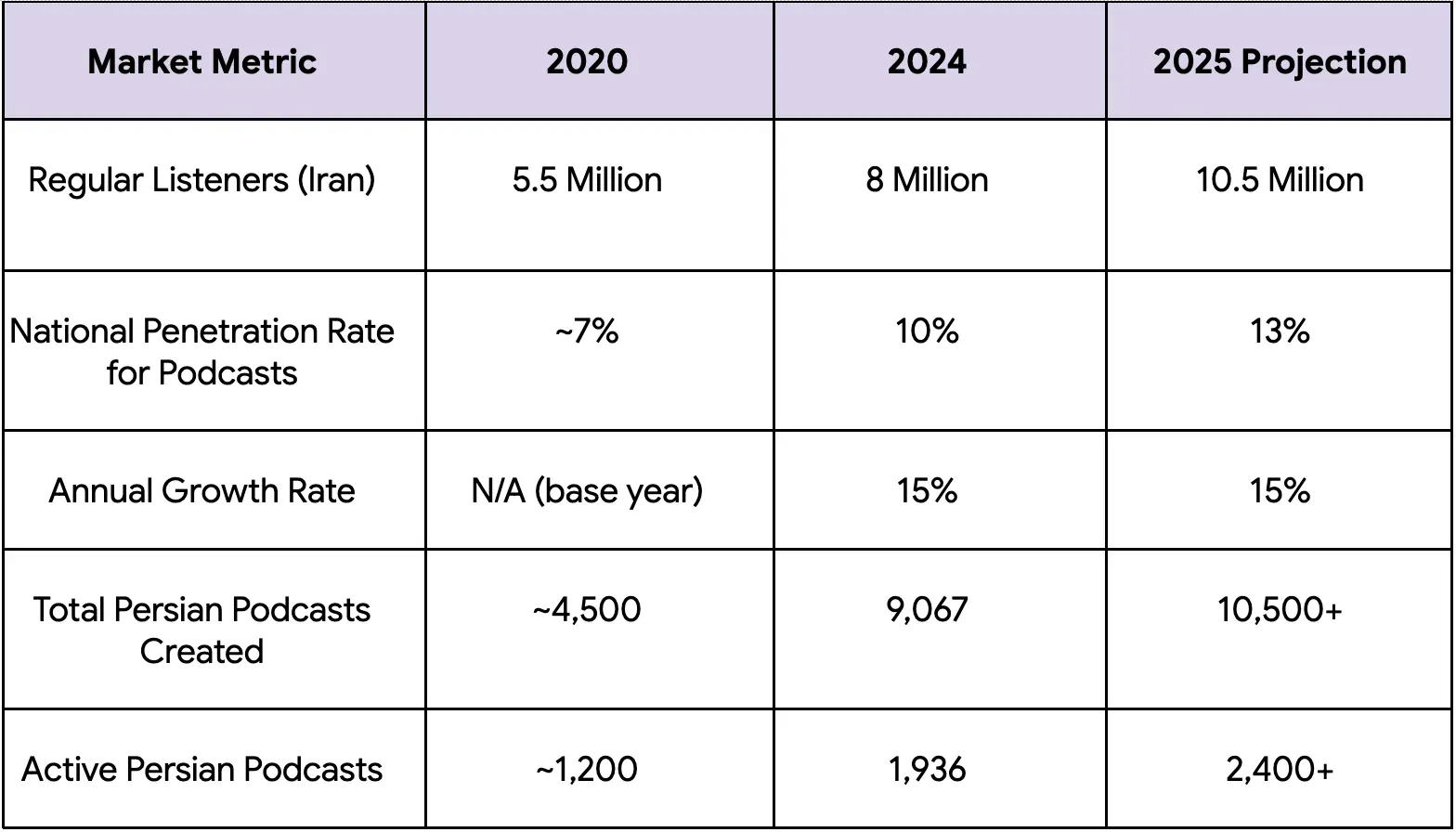
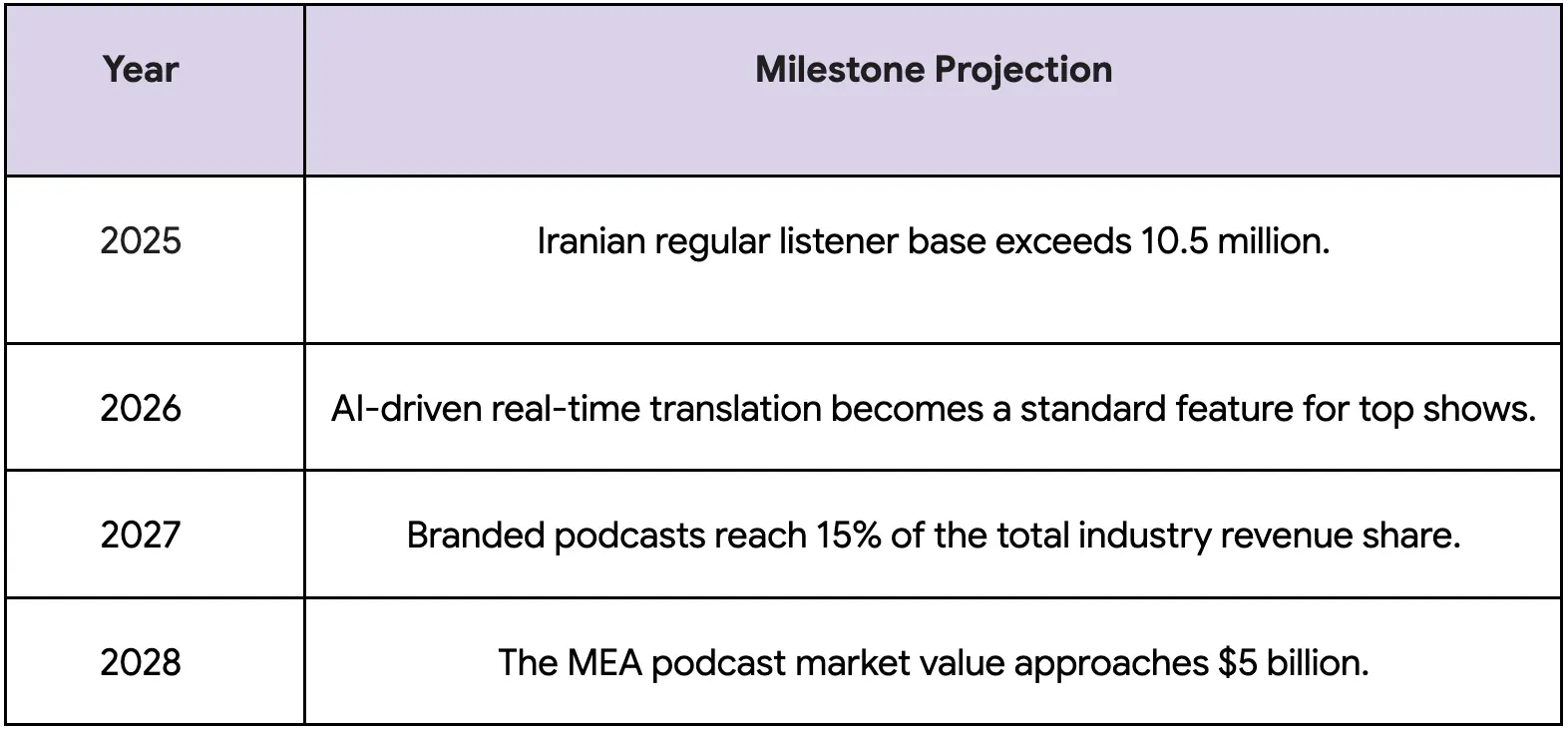
The Iranian audience has grown steadily, even with some serious internet and economic hurdles. Back in 2020, there were about 5.5 million listeners; by the end of 2025, that number was projected to cross 10.5 million.
On the creator’s side, things are just as busy. By the end of 2024, Over 9,000 Persian-language podcasts have been created, though many have gone quiet. Currently, about 20% of those (around 1,936 shows) are considered “active,” meaning they’ve put out at least ten episodes and updated recently.
So, who’s tuning in? Mostly young, educated city-dwellers. About 41% of listeners are between 20 and 30, and another 32% are in the 30-to-40 age bracket. Listeners over the age of 40 make up only 14% of the total, and those between 10-20 years old represent 13%. This concentration among 20-to-40-year-olds highlights the medium’s role as a primary source of information and entertainment for the workforce and university student population.
The gender split is fairly even, though it leans slightly more male (60%) than female (40%). Geographically, one can say it’s really a big-city game: Tehran (the capital city of Iran) is the clear leader, followed by some other major cities such as Mashhad, Isfahan, Karaj, and Shiraz. There’s also a huge “diaspora” audience listening from the US, Canada, Germany, and Australia.
Where Iranians Listen
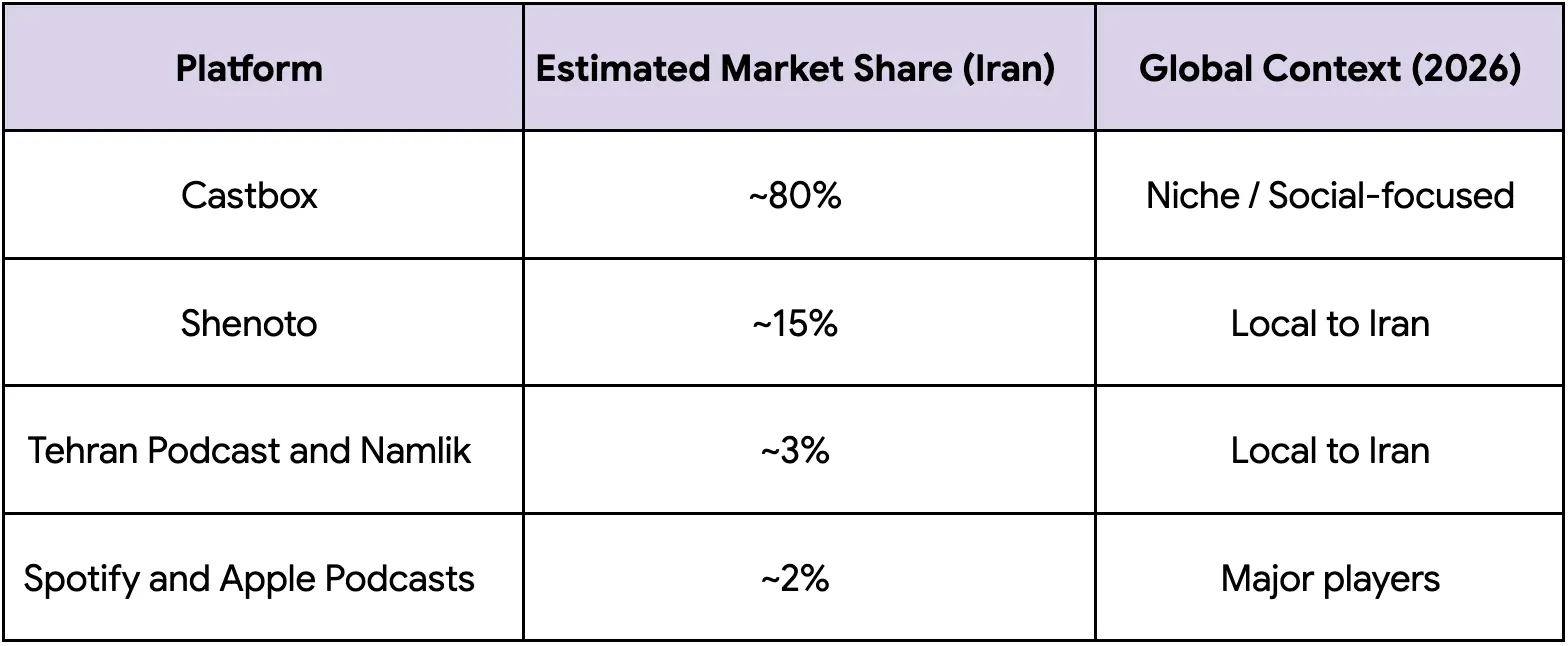
While the hierarchy of podcast platforms in 2026 is led by YouTube (39%), followed by Spotify (21%) and Apple Podcasts (8%), Iran has its own platform hierarchy. Because of the unique regulatory and economic environment of the country (especially because of the sanctions and internet access), global giants aren’t always the easiest to use. This is why the market is characterized by the extreme dominance of a single international aggregator and a burgeoning domestic hosting ecosystem.
The Castbox Crown
In Iran, Castbox is one of the leaders. It holds a massive 80% to 89% of the market. Why? Its user-friendly, high-performance interface functions reliably in Iran. Its social features, particularly the ability for users to leave comments and engage in discussions directly on episode pages, really clicked with an Iranian audience seeking community in a restricted digital space.
The Local Heroes
Domestic platforms are also stepping up. Shenoto is the largest local player, acting as both a host and a distribution app. Out of the 10,000+ Persian podcasts by early 2025, more than 8,000 use Shenoto’s services. It uses a “freemium” model, keeping most things free while offering a paid archive for top shows. It currently holds about 15-18% of the listener market. Other platforms, such as Namlik and Tehran Podcast, occupy a smaller portion of the market, together accounting for less than 3% of the total audience.
What’s Trending: It’s All About Self-Improvement
In many countries, categories such as comedy, news and sports may rule the charts, while the Iranian market exhibits a distinct “utilitarian” preference. Iranians are much more practical listeners. They mainly tune in to podcasts in order to learn skills, improve their mental health, or understand the world better.
Psychology and Learning
This is the biggest category by far. Shows like BPlus (book summaries) and Radio Rah(psychology) have some of the most massive followings. Research by the Rastak Research Center indicates that while religious and news topics have high production volumes, their actual audience share is remarkably low compared to the psychology and education sectors.
The Top Hits
The concentration of audience attention in Iran is highly intense, with a small number of “super-podcasts” capturing the majority of total listens. Total listens for Persian podcast episodes reached 696 million by 2024, with the top tier of shows accounting for a massive percentage of these interactions.

Hosted by: Podbean4.8 ★

Hosted by: Acast4.8 ★

Hosted by: Acast4.8 ★

Hosted by: Acast4.7 ★

Hosted by: Podbean4.6 ★

Hosted by: RedCircle4.8 ★

From: Jadi
Audiobooks: A Massive Market
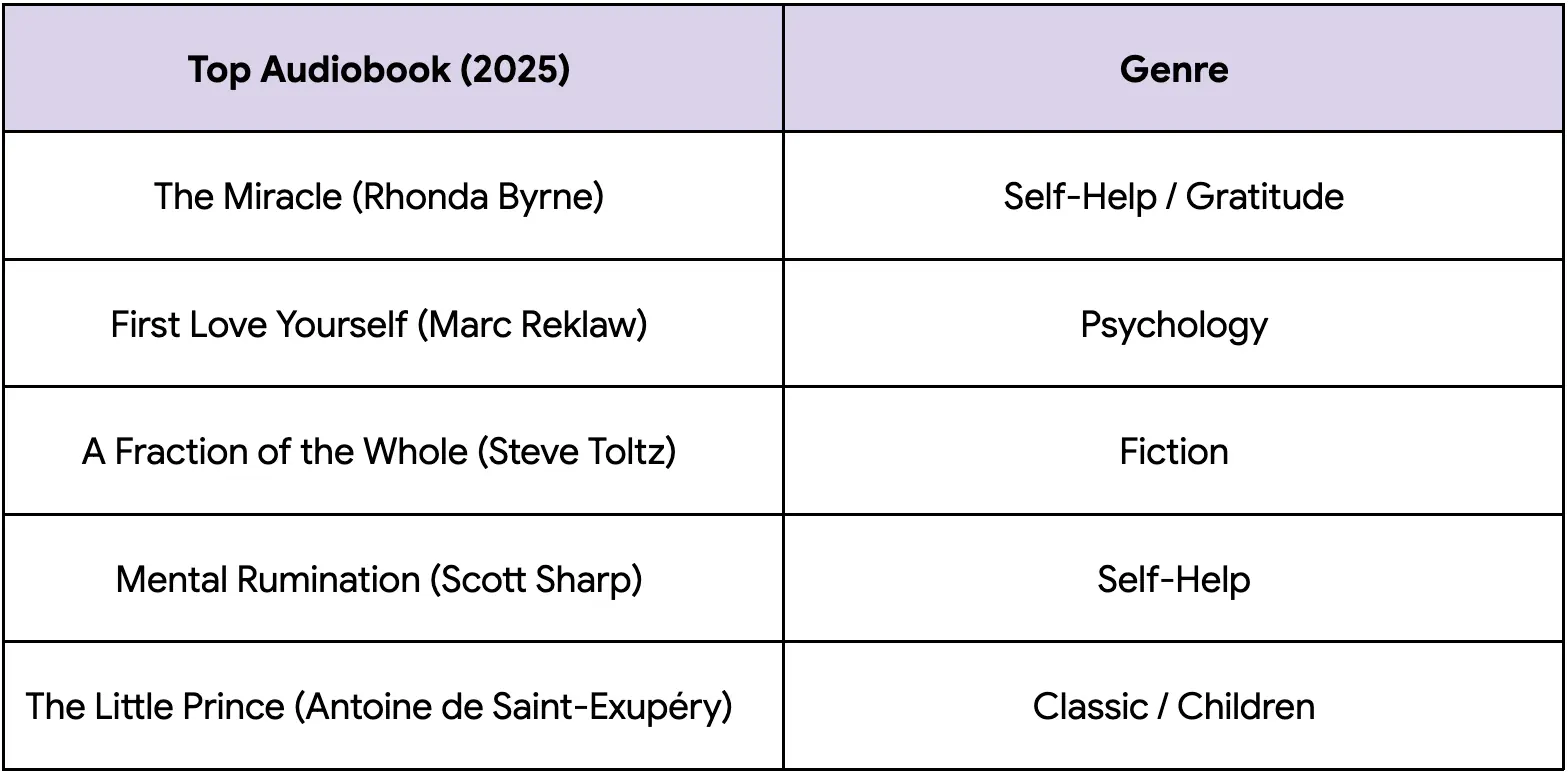
The audiobook scene in Iran is a multi-million-dollar industry. Two platforms really run the show here: Fidibo and Taaghche.
- Fidibo: Fidibo, launched in 2013 by Majid Ghasemi, was the first major platform to offer legal electronic and audio versions of Persian books. Its acquisition by Digikala (Iran’s largest e-commerce group) provided it with the capital and user base needed to dominate the early market. By early 2025, Fidibo had expanded its catalog to include thousands of titles from major publishers and specialized sectors such as the capital market.
- Taaghche: A major rival with over 15 million installs. Their latest report shows that audiobooks now dominate their best-seller lists, and their users logged over 12 million hours of study time by early 2025. Taaghche did face a major hurdle in 2023 when its license was briefly suspended by the government but the platform remains a top choice for users.9
In addition to these two platforms, Shenoto also offers more than 2000 audiobooks, mainly as part of its premium plan.
Audiobook Consumption Data
According to Taaghche’s data, audiobooks now dominate the bestseller lists in Iran. The peak hours for listening are between 10:00 PM and 1:00 AM, indicating that audiobooks have become a primary ritual for relaxation before sleep. December is the month with the highest reading and listening activity.
Startups and Production Hubs
The Persian podcasting landscape is increasingly characterized by professionalized startups and regional production hubs that serve both domestic and diaspora audiences. While many creators start as independent individuals, the top-tier shows have transitioned into media companies.
Key Audio Startups in Iran
- Shenoto (شنوتو): Founded in 2017 by Amir Hossein Madadi, Shenoto is the most comprehensive audio ecosystem in Iran. It provides hosting, distribution, and marketplace tools for 8,000+ audio creators. It has been instrumental in promoting “podcast culture” through its Android and web applications.
- Namlik (ناملیک): A focused platform for short-form audio content and professional narration of magazine articles.
- Tehran Podcast (تهران پادکست): A Persian podcast platform, curating Farsi audio content for listeners.
- Pejvak (پژواک) Festival: While not a startup, this state-supported initiative represents the institutionalization of podcasting, providing awards and recognition for audio excellence.
The Rise of the “Videocast”
A significant trend in the last 24 months is the transition of audio podcasts into “videocasts.” This shift is driven by the fact that YouTube has become the primary search engine for long-form content, even for those who primarily listen. YouTube is officially blocked in Iran, but it is “wildly popular” through the use of VPNs. Persian creators have built massive audiences on the platform, attracted by the potential for dollar-denominated income. However, YouTube’s improved location-detection systems have recently penalized creators whose audiences are primarily inside Iran. Ad revenue that previously reached $11 per thousand views has, in some cases, plummeted to $1 per thousand views because advertisers see little value in reaching a market where they cannot sell products because of sanctions.
Top Persian Videocasts and Channels (2024-2025)
The most successful videocasts blend the conversational style of a podcast with high-quality visual production. Some of these most successful channels include:
- Kouman: Known for their entertainment and food-testing videos, this duo attracts millions of views and operates in a format that mirrors conversational podcasting.
- Tabagheh 16 (طبقه ۱۶): Hosted by Soheil Alavi, this videocast features long-form interviews with startup founders and artists, focusing on the future of humanity and technology.
- MiaPlays: While primarily a vlogger, her channel is a primary example of high-engagement Persian video content with a massive following among the Gen-Z demographic.14
- Football360: Adel Ferdosipour’s platform, which features in-depth interviews and football analysis in a high-end videocast format.
The Revenue Gap: How Do They Make Money?
Monetization remains the most significant hurdle for the Iranian podcasting industry. Approximately 96% of Persian podcasts currently have no formal revenue model and are produced as passion projects or for brand-building.
The Sponsorship Dominance
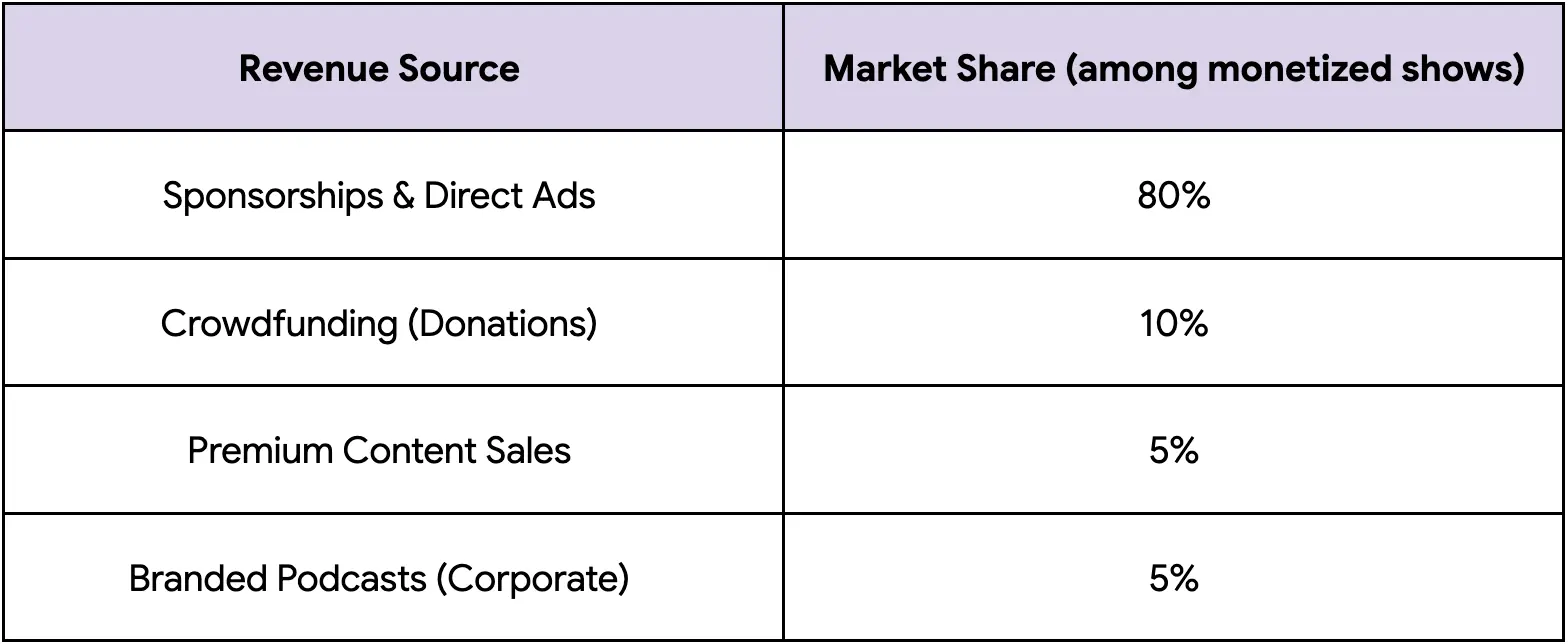
For the 4% of podcasts that do earn revenue, the sponsorship model is the primary engine. About 80% of total industry revenue comes from advertising and brand partnerships. Major Iranian tech firms, such as Digikala (Iranian alternative to Amazon) and Snapp (Iranian alternative to Uber), have been the most active sponsors, valuing the high engagement and demographic profile of podcast listeners.
CPMs and Revenue Streams
While global CPM (Cost Per Mille) rates for podcasts range from $15 to $30 for 60-second ads, the Iranian market operates on a different scale. Revenue is highly concentrated: the top 2% of podcasts capture 95% of all industry earnings.
The “Sanction Gap” prevents Iranian creators from accessing international ad-networks or platforms like Patreon. Instead, they rely on:
- Domestic Ad Networks: Agencies like Yektanet that offer podcast-specific ad placements.
- Telegram-based Ad Sales: Many podcasters use their companion Telegram channels (often with tens of thousands of members) to sell advertising.
- Direct-to-Fan Payments: Using domestic platforms like HamiBash to collect small donations from loyal listeners.
Headwinds of Persian Podcasting
Internet disruptions have a direct impact on content production (both audio and video) in Iran. For example, in late 2022 to early 2023, the production of podcast episodes in Iran dropped to 582,273, down from 664,960 in the previous year, a decline attributed to internet shutdowns and the social atmosphere following major protests. To keep listening, Iranians rely a lot on VPNs. This widespread use of VPNs complicates data for creators; for example, an advertiser may see a “German” audience for a Persian podcast, when in reality, 90% of those listeners are in Tehran using a German IP.
What’s Next for Persian Podcasts?
Despite the challenges, the outlook for the Persian podcasting industry is one of resilient (but sometimes slow) growth. Several key trends are expected to define the next five years:
Integration of Artificial Intelligence
The global podcasting market is moving toward heavy integration with AI for real-time translation, auto-captioning, and chaptering.5 For Persian creators, AI represents a path to localization and professionalization. Emerging tools will allow Iranian podcasters to automatically translate their content into English or Arabic to reach the diaspora and regional markets, potentially creating bigger audiences for Persian podcasters. Such advancements in translation can also help broaden the access of Persian listeners to global shows in other languages, impacting their taste and listening habits and possibly changing the game for the Persian podcasting platforms.
The Institutionalization of Branded Content
While branded podcasts currently account for only 5% of revenue, more Iranian businesses are starting to view them as a crucial tool for brand authority. As the “noise” on traditional social media increases, the “high-intent” environment of a 40-minute podcast episode becomes an increasingly attractive marketing channel for Iranian SMEs and corporations.
The Expansion of the “Middle-Class” Creator
Currently, the industry is dominated by a few “stars” (e.g. Bandari, Shakouri, Jadi). However, as monetization tools on platforms like Shenoto mature and domestic ad-networks become more sophisticated, we can expect a “middle class” of Persian podcasters to emerge; shows that reach 5,000 to 10,000 listeners and earn a sustainable, if modest, income.
The Persian podcasting industry also stands as a testament to the cultural resilience of the Iranian people. In the face of some major roadblocks, the industry has managed to build a sophisticated, high-quality ecosystem that competes with the best audio content globally. For the urban Iranian youth, the podcast is more than just audio; it is an open door to a world of knowledge that no physical barrier has yet been able to fully close.
The above list of podcasts is available as an OPML file for your podcast player